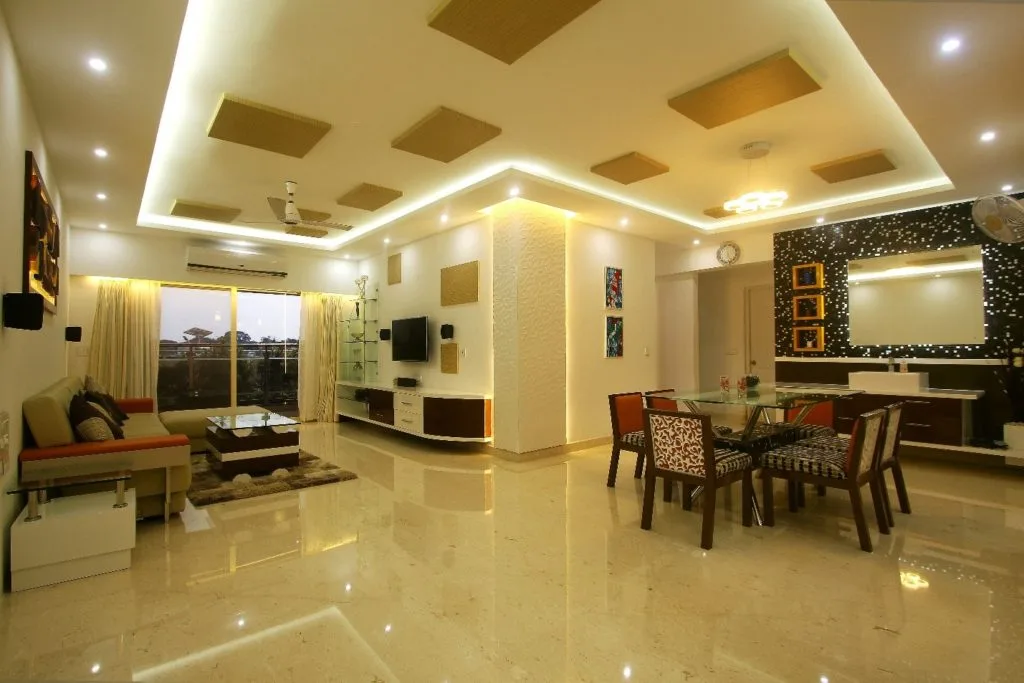
Step 1: Define Your Total Budget Before Anything Else
The most common mistake Chennai homeowners make is starting the design process without a defined total budget. This leads to scope creep — every upgrade seems reasonable in isolation but the total quietly doubles. Before you speak to a single designer, decide: "I will not spend more than ₹X on interiors." Write it down.
If you're unsure of a realistic number, use this rough guide for a semi-furnished flat (builder standard):
| Flat Type | Basic Budget | Comfortable Budget | Premium Budget |
|---|---|---|---|
| 1BHK | ₹1.5L | ₹3L | ₹5L |
| 2BHK | ₹3.5L | ₹6L | ₹10L |
| 3BHK | ₹6L | ₹10L | ₹16L |
| Villa (2000 sqft) | ₹14L | ₹22L | ₹35L+ |
Step 2: Apply the 50/30/20 Rule
Once you have a total budget, divide it like this:
- 50% — Kitchen + Master Bedroom: These two rooms have the highest daily impact and the best resale ROI. Invest here first.
- 30% — Living Room + Other Bedrooms: TV unit, false ceiling, second and third bedroom wardrobes.
- 20% — Bathrooms, Lighting, Decor + Contingency: Accessories, accent lighting, plants, art, and your 10–15% buffer.
Example for a 2BHK with ₹7L total budget: ₹3.5L for kitchen + master wardrobe, ₹2.1L for living room + second bedroom, ₹1.4L for bathrooms, lighting, and contingency (₹70K). This framework prevents the regret of blowing the budget on one room and leaving others bare.
Step 3: Prioritise Like a Professional
Used 3× daily. Most complex to install. Highest maintenance impact. Best ROI at resale. Never compromise here.
Used twice daily. A well-organised wardrobe starts every morning right. Don't settle for a basic hinged if you can afford sliding.
Where guests arrive and family spends evenings. TV unit + false ceiling + lighting here has high impression value.
Children's or guest rooms. Functional wardrobes sufficient — no need for premium finishes here.
Civil work (tiles, sanitary ware) is a separate cost. Interior scope here is mainly vanity + mirror + accessories. Can be done last.
Step 4: Get 3 Quotes on the Same Scope
Chennai's interior design market is competitive — prices for identical scope can vary 20–30% between companies. Get at least 3 quotes. For comparison to be valid:
- All 3 must price the same room list
- All 3 must specify the same material grade (e.g., all quoting acrylic shutters)
- All 3 must include GST, installation, and site supervision
- Ask each company for their exclusions list — what is not in the quote is as important as what is
Step 5: Build Your Contingency Fund
Budget 10–15% contingency on top of your quoted price. In our experience at Homeli, nearly every project has some form of scope addition — a civil repair that surfaces during demolition, an extra electrical point, an upgraded tile decision. The contingency is not for upgrades (that's lifestyle creep) — it's for genuine surprises.
If the project finishes within quote, the contingency goes back in your pocket. That's a win.
Step 6: Understand What Can Be Done Later (Phase 2)
Not every room needs to be done on Day 1. A phased approach helps if the full budget isn't available. Phase 1 should cover everything you need to move in comfortably — kitchen, one wardrobe, basic living room. Phase 2 (6–12 months later) adds the rest. Use our cost calculator to plan both phases.
Frequently Asked Questions
10–15% of your total interior budget. Nearly every project has some scope addition. Keep this separate — it's not for upgrades, only for genuine on-site surprises.
Modular kitchen first — it has the highest daily-use impact and best ROI. Then master bedroom wardrobe. Then living room. Other bedrooms and bathrooms can come last.
Get 3 quotes on identical scope: same room list, same material grade, inclusive of GST and installation. Always ask for an exclusions list from each company.
50% to kitchen + master bedroom (highest impact), 30% to living room + other rooms, 20% to bathrooms + lighting + decor + 10–15% contingency. This prevents overspending on one room while leaving others bare.
Also see: How Quotes Are Calculated · Hidden Costs Nobody Tells You · How to Save Money on Interiors · Cost Calculator